

Best for starting a prayer routine: a guided journal. Best for writing freely: an open-page journal. Best for praying through Scripture: a Scripture reflection journal. These nine Christian prayer journal formats for women serve different habits; choose the page you will actually return to.
- Among Christian prayer journal formats for women, guided pages suit beginners; open pages suit unstructured prayer.
- Choose Scripture reflection pages when you want Bible reading and prayer in one place.
- Princesses! is a sisterhood guide to read alongside a journal, not a prayer journal.
Why this matters
A prayer journal gives you somewhere to return to a concern, a Scripture passage, or a prayer you have struggled to put into words. The right format makes that return easier. A heavily prompted book can help when you face a blank page; the same prompts can feel restrictive when you need space to write at length.
For 2026, start with your practice rather than a cover or a promise of transformation. This guide compares formats, not named products or hands-on tests. If you want to bring what you write into your relationships, Princesses! is a digital guide to loving your sisters and yourself; it is not a prayer journal.
What makes the best prayer journal for you?
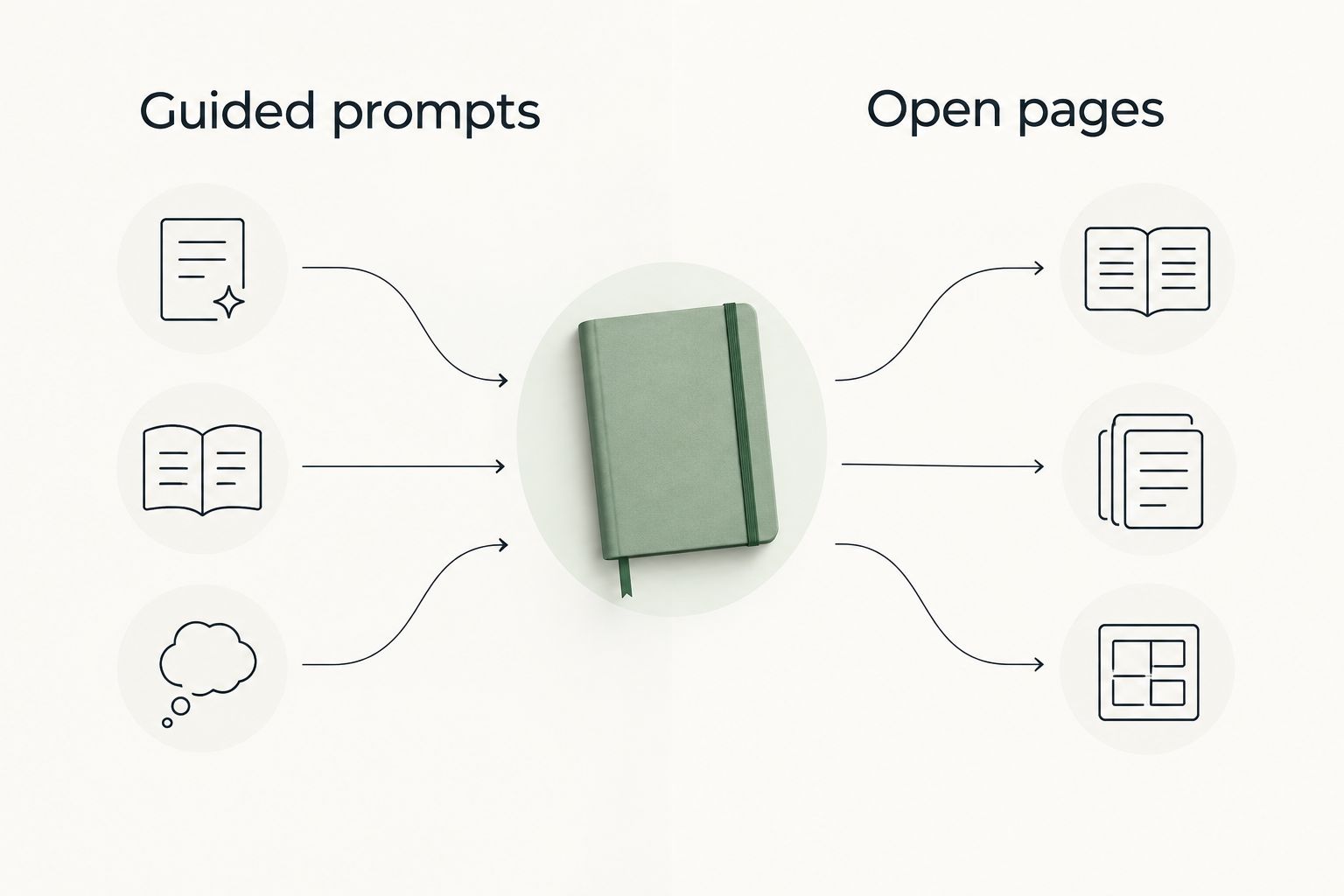
- Guided prompts: Choose questions or sentence starters if beginning is your main obstacle. Check that the prompts invite honest answers rather than a particular emotional tone.
- Open pages: Choose room for uninterrupted writing if your prayers vary in length or subject. Too little structure can make it harder to resume a routine.
- Scripture space: Decide whether you want to copy a passage, note a reference, or reflect on what you read. A dedicated section helps only if you plan to use it.
- Review pages: Look for a way to revisit earlier entries. Prayer journaling is not just recording requests; it can also help you notice how your understanding has changed.
- Practical fit: Consider whether you will write at home, carry the journal, or keep it beside a Bible. A format that fits your setting is easier to keep using.
In 2026, no single layout wins every category. Guided prompts solve the blank-page problem; open pages protect room for a prayer that does not fit a template. Start by deciding which of those needs is stronger.
Nine Christian prayer journal formats at a glance
These are page formats, not rankings of products or claims about a particular seller. Check a journal's actual pages before buying it.
| Format | Best for | Standout feature | Key limitation |
|---|---|---|---|
| Guided prayer journal | Starting a routine | Writing prompts | Less freedom to change direction |
| Open-page prayer journal | Uninterrupted writing | Flexible space | No built-in starting point |
| Scripture reflection journal | Reading and responding | Passage-focused entries | Less suited to unrelated prayers |
| Gratitude prayer journal | Noticing thanks | Repeated gratitude focus | Hard topics can get pushed aside |
| Prayer-request tracker | Following up on requests | Space to revisit concerns | Can become a list without reflection |
| Lament journal | Writing through grief | Room for difficult prayers | Not every day calls for that focus |
| Intercessory prayer journal | Praying for others | People-focused entries | Your own needs can disappear |
| Sermon reflection journal | Responding to teaching | Notes linked to a message | Depends on a regular teaching habit |
| Undated daily journal | Returning after a break | No fixed calendar | Requires you to set your own pace |
1. Guided prayer journal: best for starting a routine
A guided prayer journal gives you a prompt to answer instead of asking you to fill an empty page. Look for questions that allow both praise and difficulty; a prompt should start your prayer, not dictate what you must feel.
Guided prayer journal pros:
- Provides a starting point.
- Helps you return when words feel hard to find.
- Gives each entry a clear focus.
Guided prayer journal cons:
- Prompts can become repetitive.
- Limited writing space can cut a prayer short.
Best for: Women who want help beginning an entry. Verdict: Buy for structure; skip if you prefer to write without cues.
2. Open-page prayer journal: best for uninterrupted writing
An open-page journal leaves the direction and length of each prayer to you. It works when you want to move between Scripture, questions, and personal concerns without fitting them into separate boxes.
Open-page prayer journal pros:
- Gives you control over each entry.
- Makes room for changing subjects.
- Accommodates short notes and longer reflections.
Open-page prayer journal cons:
- A blank page can be hard to begin.
- Earlier themes take effort to find again.
Best for: Women with an established writing habit. Verdict: Buy for freedom; hold if prompts help you show up.
3. Scripture reflection journal: best for reading and responding
This format organizes an entry around a passage you have read. You can record the reference, write what stands out, and turn that response into a prayer. The passage gives the entry its starting point.
Scripture reflection journal pros:
- Keeps reading and prayer together.
- Gives you a subject to return to.
- Encourages attention to the text.
Scripture reflection journal cons:
- Passage-focused space can crowd out other concerns.
- It is less useful when you want to write without a reading plan.
Best for: Women who want their journal to follow Bible reading. Verdict: Buy for passage-led reflection.
4. Gratitude prayer journal: best for noticing thanks
A gratitude-focused format asks you to name what you are thankful for and bring it into prayer. That focus is useful when thanks gets lost among requests. Leave yourself permission to write about hardship too.
Gratitude prayer journal pros:
- Gives entries a clear theme.
- Makes small moments easier to record.
- Encourages you to revisit what you noticed.
Gratitude prayer journal cons:
- A gratitude-only layout can feel restrictive.
- It does not replace space for grief or questions.
Best for: Women who want a regular place for prayers of thanks. Verdict: Buy as a focused format, not your only outlet.
5. Prayer-request tracker: best for following up
A request tracker keeps a concern visible after the day you first write it down. Choose one that leaves room to update your thoughts, not just mark an outcome. People and situations rarely fit a simple completed box.
Prayer-request tracker pros:
- Helps you revisit earlier requests.
- Keeps names and concerns together.
- Makes follow-up intentional.
Prayer-request tracker cons:
- Lists can become mechanical.
- Outcome boxes can oversimplify an ongoing situation.
Best for: Women who regularly pray about continuing concerns. Verdict: Buy if follow-up matters more than free writing.
6. Lament journal: best for writing through grief
A lament journal makes room to address God honestly about loss, anger, or confusion. You do not need to resolve an entry before closing the book. Look for enough open space to say what is actually on your mind.
Lament journal pros:
- Allows difficult feelings onto the page.
- Does not require a cheerful closing line.
- Supports longer, unhurried entries.
Lament journal cons:
- Its focus will not fit every writing day.
- Tight prompts can limit honest expression.
Best for: Women who need space for difficult prayers. Verdict: Buy for honest expression; skip a format that rushes you toward an answer.
7. Intercessory prayer journal: best for praying for others
An intercessory format organizes entries around people or communities you want to pray for. It helps you return to a concern rather than treating each mention as a separate entry. Keep room for your own prayers as well.
Intercessory prayer journal pros:
- Keeps people and concerns easy to revisit.
- Gives ongoing prayers a place.
- Helps you write beyond a simple list of names.
Intercessory prayer journal cons:
- Your personal reflections can get crowded out.
- A rigid layout can reduce people to categories.
Best for: Women who want to pray regularly for others. Verdict: Buy for that purpose; pair it with open writing space.
8. Sermon reflection journal: best for responding to teaching
A sermon reflection format gives you somewhere to record a teaching point, a Scripture reference, and your response in prayer. It is strongest when you return to the notes after the service rather than treating them as a transcript.
Sermon reflection journal pros:
- Links notes with personal response.
- Makes a message easier to revisit.
- Gives a specific starting point for prayer.
Sermon reflection journal cons:
- Depends on a teaching routine.
- Note-taking space might displace personal prayer.
Best for: Women who want to pray through what they hear. Verdict: Buy if you revisit your notes.
9. Undated daily journal: best for returning after a break
An undated journal lets you write on the days you choose without leaving printed dates empty. You still have to decide what belongs in an entry. Add a simple prompt of your own if a blank page slows you down.
Undated daily journal pros:
- Leaves your schedule open.
- Avoids unused dated pages.
- Lets entries vary in length and focus.
Undated daily journal cons:
- Offers little built-in direction.
- A break can stretch unless you set a return point.
Best for: Women who want a flexible 2026 writing rhythm. Verdict: Buy for flexibility; hold if a daily prompt keeps you engaged.
How to use this comparison
These formats are grouped by what they help you do: begin writing, make room for honest prayer, respond to Scripture, or revisit a concern. Their order is a decision aid, not a claim that specific journals were tested or ranked against each other.
Which prayer journal should you choose?
Choose guided prompts if getting started is the hard part; choose open pages if you already know what you need to say. If you read Scripture before you write, choose a layout that keeps the passage and your response together.
In 2026, the default for an undecided writer is a format with enough guidance to begin and enough room to continue. Do not choose a request tracker merely because you make requests, or a gratitude journal because gratitude matters to you. Choose the page you would still use when your prayer does not fit its expected theme.
If your journal entries keep returning to friendships, family, or how you treat yourself, Dona LaTarsha Nesbit's Princesses! offers stories and activities to reflect on alongside your prayers. It is a companion to your journal, not another prayer-journal pick.
FAQ
What's the best Christian prayer journal format for women in 2026?
Guided pages are best if you need help beginning; open pages are best if you want freedom to write. Compare actual journal layouts before choosing a product.
Is a guided prayer journal better than a blank one?
A guided prayer journal is better when you need help beginning; a blank one is better when you want freedom to write. Choose according to what usually stops you from returning to the page.
What should I write in a Christian prayer journal?
Write a prayer, a Scripture reflection, a concern, or a question you want to revisit. You do not have to make every entry follow the same pattern.
Do I need to journal every day?
No, you do not need to journal every day. An undated format lets you return without treating missed days as empty assignments.
Can I use a prayer journal for difficult emotions?
Yes, a prayer journal can hold grief, anger, and uncertainty as well as gratitude. Choose open writing space if fixed prompts make it hard to say what you mean.
What's the difference between a prayer journal and a prayer-request tracker?
A prayer journal can hold full prayers and reflections, while a request tracker focuses on concerns you want to revisit. Choose a tracker when follow-up is your main need.
How do I choose a journal for Bible reading?
Choose a Scripture reflection journal with room for a passage reference and your response. That layout keeps reading connected to prayer without requiring every entry to cover a new topic.
One last thing
Before you choose a journal for 2026, write one prayer on an ordinary sheet of paper. Notice whether you wanted a question to answer, more room to continue, or a place to revisit it later. That answer is a better guide to the right format than any ranked list.